6.4 - Refrigerant Safety Classifications
Module: Safety Leak Detection Shipping and Safe Disposal
Technical verification date: August 10, 2026
Primary technical authority: ANSI/ASHRAE Standard 34-2024, Designation and Safety Classification of Refrigerants, together with current published addenda and current ASHRAE refrigerant-designation information
Course role: Introduces the toxicity and flammability classification system used to describe refrigerant hazards and explains why the assigned safety group affects equipment, service tools, ventilation, ignition control, and code requirements
Learning Objectives
After completing this section, a student should be able to:
- Distinguish toxicity Class A from toxicity Class B.
- Distinguish flammability Classes 1, 2L, 2, and 3.
- Interpret combined refrigerant safety groups such as A1, A2L, A2, A3, B1, and B2L.
- Explain why an A1 refrigerant is not automatically harmless and why an A2L refrigerant is not the same as a nonflammable refrigerant.
- Explain how refrigerant safety classification affects equipment design, service tools, ventilation, ignition-source control, charge limits, and applicable codes.
- Use current ASHRAE information rather than outdated study-guide classifications when identifying a refrigerant safety group.
Introduction
A refrigerant number such as:
R-410A
R-32
R-454B
R-290
R-717
identifies the refrigerant, but the refrigerant number by itself does not tell a technician how hazardous the refrigerant is to people or how readily it can propagate flame.
ASHRAE Standard 34 provides a separate safety classification based on two major characteristics:
TOXICITY
+
FLAMMABILITY
The result is an alphanumeric safety group such as:
A1
A2L
A2
A3
B1
B2L
The letter describes toxicity.
The number or number-letter combination describes flammability.
For example:
A2L
means:
A
→ lower toxicity class

2L
→ lower-flammability subclass with low burning velocity
This classification is important because refrigerants with different safety groups can require different:
- Equipment designs.
- Charge limits.
- Ventilation provisions.
- Refrigerant-detection provisions.
- Ignition-source controls.
- Recovery equipment.
- Service tools.
- Installation procedures.
- Machinery-room provisions.
- Building, mechanical, fire, and product-safety requirements.
The safety group is therefore not simply a label to memorize for the certification examination. It is a compact description of hazards that influences how the refrigerant is used and serviced.
Key Concepts
1. ASHRAE Standard 34 Defines Refrigerant Safety Groups
ASHRAE Standard 34 establishes a uniform system for:
- Refrigerant designations.
- Safety classifications.
- Refrigerant concentration limits.
- Supporting refrigerant property information used by related safety standards.
The safety classification combines:
TOXICITY LETTER
+
FLAMMABILITY CLASS
A simplified matrix is:
| Toxicity | Class 1 | Class 2L | Class 2 | Class 3 |
|---|---|---|---|---|
| A — lower toxicity | A1 | A2L | A2 | A3 |
| B — higher toxicity | B1 | B2L | B2 | B3 |
This table is the foundation for interpreting refrigerant safety-group labels.
2. The Letter Describes Toxicity
ASHRAE uses two toxicity classes:
A
→ lower toxicity
B
→ higher toxicity
The classification is based on occupational-exposure and toxicological information rather than on whether a refrigerant is simply called “toxic” or “nontoxic” in everyday language.
A commonly used threshold in the Standard 34 toxicity framework is:
400 ppm
At an introductory level:
- Class A corresponds to the lower-toxicity side of the classification framework.
- Class B corresponds to the higher-toxicity side.
The current Standard 34 methodology uses an occupational exposure limit (OEL) and supporting toxicity data when establishing the classification.
Do not interpret the letter as:
A = harmless
B = deadly
The letter is a relative safety classification, not permission to ignore exposure controls.
3. Class A Does Not Mean “Nontoxic”
A Class A refrigerant can still be dangerous at high concentration.
Possible hazards may include:
- Oxygen displacement.
- Asphyxiation.
- Central-nervous-system effects.
- Cardiac effects.
- Frostbite from liquid contact.
- Thermal-decomposition products.
- High-pressure release.
For example:
A1
does not mean:
safe to breathe at any concentration
It means the refrigerant is in:
lower toxicity class A
+
flammability class 1
under the Standard 34 classification system.
The exposure and asphyxiation hazards were developed in Sections 6.1 and 6.2.
4. Class B Means Higher Toxicity
Class B refrigerants have the higher-toxicity designation within the Standard 34 system.
This can affect:
- Allowable refrigerant quantity.
- Equipment location.
- Machinery-room requirements.
- Ventilation.
- Detection.
- Emergency procedures.
- Service PPE and respiratory planning.
Examples of refrigerants that illustrate B classifications include:
- R-514A — B1 in current ASHRAE/UNEP published refrigerant information.
- R-717 ammonia — B2L in ASHRAE Standard 34 information.
These examples are useful because they demonstrate that toxicity and flammability are separate axes.
A refrigerant can be:
higher toxicity
+
no flame propagation
→ B1
or:
higher toxicity
+
lower flammability / low burning velocity
→ B2L
5. The Number Describes Flammability
ASHRAE’s flammability system uses:
1
2L
2
3
The general progression is:
Class 1
→ no flame propagation under the specified test conditions
Class 2L
→ lower flammability with low burning velocity
Class 2
→ lower flammability
Class 3
→ higher flammability
This progression should not be treated as a simple linear “danger score.”
Actual risk also depends on:
- Refrigerant quantity.
- Room volume.
- Leak rate.
- Ventilation.
- Ignition sources.
- Equipment design.
- Occupancy.
- Installation configuration.
- Code-required mitigation.
6. Class 1 Means No Flame Propagation Under the Standard Test
Class 1 refrigerants do not exhibit flame propagation when tested under the conditions defined by Standard 34.
A common example is:
R-410A
→ A1
The correct interpretation is:
A
→ lower toxicity

1
→ no flame propagation under the Standard 34 test classification
Do not rewrite Class 1 as:
cannot burn or react under any imaginable condition
As discussed in Section 6.3, refrigerants can still create:
- Thermal-decomposition hazards.
- Oxygen-displacement hazards.
- Pressure hazards.
- Dangerous mixtures under abnormal conditions.
7. Class 2L Is a Lower-Flammability Subclass
Class 2L identifies refrigerants in the lower-flammability category that also have a low burning velocity.
ASHRAE describes 2L refrigerants as burning very slowly compared with higher-flammability classifications.
The commonly cited burning-velocity threshold is:
10 cm/s
The practical idea is:
2L
→ flame propagation is possible
→ but burning velocity is limited by the 2L classification criterion
Examples include:
R-32
→ A2L
R-454B
→ A2L
The current ASHRAE/UNEP refrigerant information lists R-454B as A2L.
8. A2L Does Not Mean Nonflammable
This distinction is extremely important.
A2L
≠
A1
An A2L refrigerant can propagate flame under the applicable test conditions.
Therefore:
A2L
→ ignition-source control matters
→ refrigerant-specific tools may be required
→ ventilation and leak mitigation may be required
→ equipment must be approved for the refrigerant
A2L is often described informally as mildly flammable or lower flammability.
For this project, the more technically useful wording is:
A2L is a lower-toxicity, lower-flammability refrigerant class with low burning velocity.
9. Class 2 Has Greater Flammability Than 2L Within the Classification Framework
Class 2 refrigerants exhibit flame propagation and meet the Class 2 criteria but do not qualify for the low-burning-velocity 2L subclass.
A current ASHRAE/UNEP example is:
R-512A
→ A2
For EPA 608 preparation, the main distinction is:
2L
→ lower flammability with low burning velocity
versus:
2
→ lower flammability without the 2L low-burning-velocity designation
Detailed laboratory flammability calculations are not required for this section.
10. Class 3 Represents Higher Flammability
Class 3 refrigerants are in the higher-flammability category.
Common examples include hydrocarbons such as:
R-290 propane
→ A3
R-600a isobutane
→ A3
The A3 label means:
A
→ lower toxicity
3
→ higher flammability
Class A3 refrigerants can require strict:
- Charge limits.
- Ignition-source control.
- Service-tool compatibility.
- Ventilation.
- Equipment listing.
- Refrigerant-specific servicing procedures.
11. Toxicity and Flammability Must Be Read Independently
The two parts of the safety group answer different questions.
For:
A3
do not think:
"3 means more toxic"
The correct interpretation is:
A
→ toxicity

3
→ flammability
Likewise:
B1
means:
B
→ higher toxicity

1
→ no flame propagation under the specified classification test
This two-axis interpretation prevents many classification errors.
Technical or Regulatory Details
1. Current Standard Basis
ASHRAE identifies:
ANSI/ASHRAE Standard 34-2024
Designation and Safety Classification of Refrigerants
as the current edition available through its standards program.
ASHRAE states that Standard 34 assigns safety classifications based on:
- Toxicity data.
- Flammability data.
The 2024 edition also added or updated information for newer refrigerants and added burning-velocity data for flammable refrigerants.
Because Standard 34 is maintained through addenda:
The current edition and all applicable published addenda should be checked when the exact safety group matters.
2. Toxicity Classification Is Not the Same as an Exposure Limit
The safety letter and an exposure limit are related, but they are not the same thing.
For example:
A
→ toxicity classification
while:
OEL
→ numerical occupational exposure limit
A technician should not replace the refrigerant-specific OEL with the letter A.
Likewise, a Class B refrigerant does not have one universal exposure limit shared by all B refrigerants.
Use the current:
- SDS.
- Standard 34 information.
- Manufacturer data.
- Workplace exposure-control requirements.
3. Flammability Class Is Not a Universal Concentration Limit
The number:
1
2L
2
3
is a classification.
It is not itself:
- A lower flammability limit in percent.
- An upper flammability limit.
- A room concentration alarm setpoint.
- A refrigerant charge limit.
- A ventilation rate.
Those values depend on the refrigerant and application.
4. The Safety Group Is Separate From ODP and GWP
Do not confuse the safety classification with environmental properties.
| Property | What It Describes |
|---|---|
| ODP | Potential for stratospheric ozone depletion |
| GWP | Climate-warming effect relative to a reference gas over a stated time horizon |
| Safety group | Toxicity and flammability classification |
| Refrigerant designation | Refrigerant identity or composition designation |
A refrigerant can have:
- Low ODP and high flammability.
- Zero ODP and lower flammability.
- Low GWP and higher flammability.
- High GWP and Class 1 flammability.
There is no rule such as:
low GWP
→ automatically safer
or:
A1
→ low GWP
5. The Safety Group Is Separate From Refrigerant Pressure Classification
Do not confuse:
A1 / A2L / A3 / B2L
with:
low-pressure appliance
medium-pressure appliance
high-pressure appliance
very-high-pressure appliance
The first describes refrigerant toxicity and flammability.
The second is part of the Section 608 appliance/refrigerant-pressure framework used for service and certification purposes.
For example, a technician cannot determine Type II or Type III certification merely by seeing A1.
6. Classification Affects Equipment Design
A refrigeration appliance is designed and listed for specific refrigerants or refrigerant classes.
Changes in safety group can affect:
- Electrical components.
- Refrigerant detectors.
- Airflow pathways.
- Charge limits.
- Enclosure design.
- Leak-mitigation controls.
- Labeling.
- Installation clearances.
- Service access.
- Pressure relief and emergency provisions.
Therefore:
A refrigerant should never be substituted solely because its pressures or cooling capacity appear similar.
The refrigerant must be approved for the equipment and application.
7. Classification Affects Service Tools
A tool that is suitable for an A1 refrigerant is not automatically suitable for:
- A2L.
- A2.
- A3.
- B-class refrigerants.
Potentially affected service equipment includes:
- Recovery machines.
- Vacuum pumps.
- Electronic leak detectors.
- Refrigerant scales with electrical components.
- Charging equipment.
- Spark-producing tools.
- Electrical test equipment used in a potentially flammable atmosphere.
For flammable refrigerants, the technician must use tools and equipment approved or identified as suitable for the refrigerant and service procedure.
8. Classification Affects Ventilation and Leak Mitigation
A refrigerant release can create:
- Toxicity hazard.
- Flammability hazard.
- Oxygen-displacement hazard.
The safety classification helps determine which hazard-control provisions may apply.
Depending on the system and code, controls can include:
- Natural ventilation.
- Mechanical ventilation.
- Refrigerant detection.
- Circulation fans.
- Automatic mitigation controls.
- Machinery-room requirements.
- Emergency exhaust.
- Charge restrictions.
The exact numerical requirements are not universal and should not be inferred from the safety-group label alone.
Detailed machinery-room safety is covered in Section 6.7.
9. Classification Affects Ignition-Source Control
For:
A2L
A2
A3
B2L
B2
B3
flammability is part of the safety classification.
The installation or service procedure may therefore control:
- Open flames.
- Smoking.
- Electrical arcing.
- Hot work.
- Non-rated electrical equipment.
- Static or spark hazards.
- Location of ignition sources relative to potential leak zones.
The exact requirements depend on:
- Refrigerant.
- Charge.
- Equipment listing.
- Occupancy.
- Code.
- Manufacturer instructions.
10. Classification Affects Code Requirements
ASHRAE Standard 34 classifies refrigerants.
ASHRAE Standard 15 provides system-safety requirements for refrigeration systems using those refrigerants.
A useful distinction is:
Standard 34
→ What is the refrigerant's designation and safety classification?
Standard 15
→ How may refrigeration systems using that refrigerant be safely applied?
Other requirements can come from:
- Building codes.
- Mechanical codes.
- Fire codes.
- Electrical codes.
- Product safety standards.
- Equipment listings.
- State and local rules.
The safety classification is therefore an input to the safety decision—not the complete code by itself.
11. A Refrigerant’s Safety Classification Can Be Updated
Safety classifications are not merely historical labels.
They can change when:
- New toxicity information becomes available.
- New flammability data become available.
- Test methods change.
- The standard is revised.
- A new subclass is established.
An important historical example is the introduction and application of the 2L subclass.
Older references may show refrigerants such as:
R-32
R-717
R-1234yf
under an older Class 2 designation.
ASHRAE later classified these in the 2L subclass based on burning-velocity criteria:
R-32
→ A2L
R-717
→ B2L
R-1234yf
→ A2L
Therefore:
Do not rely on an old study guide for a current refrigerant safety classification.
12. Current Examples for Examination and Field Recognition
The following examples are useful for introductory recognition.
| Refrigerant | Current / Representative Safety Group | Primary Teaching Point |
|---|---|---|
| R-410A | A1 | Lower toxicity; Class 1 |
| R-32 | A2L | Lower toxicity; lower flammability; low burning velocity |
| R-454B | A2L | Modern lower-GWP residential/light-commercial refrigerant example |
| R-512A | A2 | Example of Class 2 without the 2L designation |
| R-290 propane | A3 | Lower toxicity; higher flammability |
| R-600a isobutane | A3 | Common hydrocarbon small-appliance example |
| R-514A | B1 | Higher toxicity; Class 1 |
| R-717 ammonia | B2L | Higher toxicity; lower flammability with low burning velocity |
Important: This table is for teaching recognition. When a safety classification controls an actual service or design decision, verify the refrigerant against the latest edition of Standard 34 and its current addenda.
Interpreting Common Safety Groups
A1
A1
=
lower toxicity
+
Class 1 flammability
Typical implications:
- No flame propagation under the Standard 34 classification test.
- Still requires exposure control.
- Still can displace oxygen.
- Still can cause frostbite.
- Still can produce hazardous thermal-decomposition products.
- Still requires refrigerant-compatible recovery and service equipment.
A2L
A2L
=
lower toxicity
+
lower flammability
+
low burning velocity
Typical implications:
- Do not treat as nonflammable.
- Control ignition sources.
- Use approved service equipment.
- Follow manufacturer ventilation and leak-mitigation procedures.
- Observe charge limits and code requirements.
A2
A2
=
lower toxicity
+
lower flammability
Typical implications:
- Flame propagation is possible.
- The refrigerant does not carry the 2L low-burning-velocity subclass.
- Ignition-source and ventilation controls remain important.
A3
A3
=
lower toxicity
+
higher flammability
Typical implications:
- Strong ignition-source control.
- Refrigerant-specific equipment and tools.
- Careful charge limitation.
- Ventilation and code restrictions.
- Specialized service procedures.
B1
B1
=
higher toxicity
+
Class 1 flammability
Typical implications:
- Toxicity controls can be more restrictive.
- Class 1 does not eliminate exposure or asphyxiation hazards.
- Machinery-room, ventilation, detection, and emergency provisions may apply.
B2L
B2L
=
higher toxicity
+
lower flammability
+
low burning velocity
R-717 ammonia is an important example.
The classification indicates that both:
- Toxicity.
- Flammability.
must be addressed.
A technician must not focus on only one of the two hazards.
B2 and B3
The matrix also permits:
B2
B3
These represent:
B
→ higher toxicity
combined with:
2
→ lower flammability
or:
3
→ higher flammability
They are less commonly encountered in ordinary residential HVAC service, but they are valid safety-group combinations within the classification framework.
Important Terms
ANSI/ASHRAE Standard 34
ANSI/ASHRAE Standard 34, Designation and Safety Classification of Refrigerants, establishes the refrigerant designation and safety-classification framework based on toxicity and flammability data.
Safety Group
The combined toxicity and flammability classification assigned to a refrigerant.
Examples include:
- A1.
- A2L.
- A2.
- A3.
- B1.
- B2L.
Toxicity Class A
The lower-toxicity class in the Standard 34 safety-classification system.
Toxicity Class B
The higher-toxicity class in the Standard 34 safety-classification system.
Flammability Class 1
A refrigerant classification indicating no flame propagation under the specified Standard 34 test conditions.
Flammability Class 2L
A lower-flammability subclass characterized by low burning velocity.
Flammability Class 2
A lower-flammability classification for refrigerants that exhibit flame propagation but are not assigned to the 2L low-burning-velocity subclass.
Flammability Class 3
The higher-flammability refrigerant classification.
Burning Velocity
The speed at which a flame front propagates through a combustible refrigerant-air mixture under the specified test conditions.
Burning velocity is one of the properties used to distinguish Class 2L from other flammable classifications.
Occupational Exposure Limit (OEL)
A numerical concentration used in occupational-health evaluation.
Standard 34 uses occupational-exposure and toxicity information in the safety-classification framework.
An OEL is not the same thing as the A/B safety letter.
Lower Flammability Limit (LFL)
The lower refrigerant concentration at which flame propagation can occur under specified test conditions.
The LFL is refrigerant-specific and is not the same as the class number.
Refrigerant Concentration Limit (RCL)
A refrigerant-specific concentration limit established within Standard 34 and used by related refrigeration safety requirements.
An RCL is not a universal value shared by all refrigerants in the same safety group.
Figures and Diagrams
Figure 6.4.1
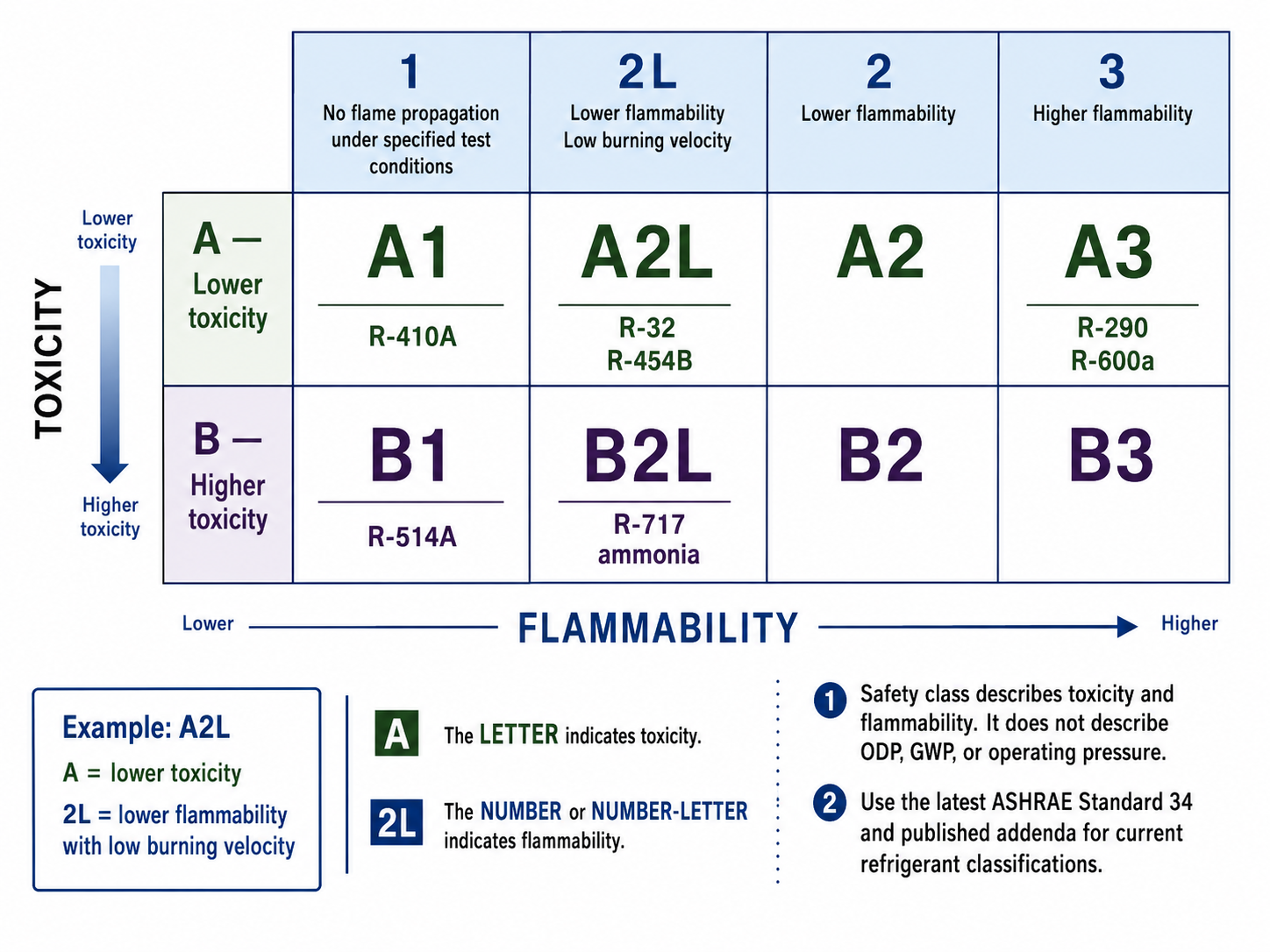
Figure 6.4.1 – Refrigerant safety groups combine toxicity class with flammability class.
AI-generated instructional figure: It may contain visual inaccuracies. Use the accompanying lesson text and cited authoritative sources to verify technical and regulatory details.
EPA 608 Exam Focus
What Students Must Remember
The most important decoding rule is:
LETTER
→ toxicity
NUMBER / NUMBER-LETTER
→ flammability
Toxicity
A
→ lower toxicity
B
→ higher toxicity
Flammability
1
→ no flame propagation under specified test conditions
2L
→ lower flammability with low burning velocity
2
→ lower flammability
3
→ higher flammability
High-Priority Interpretations
A1
→ lower toxicity + Class 1
A2L
→ lower toxicity + lower flammability / low burning velocity
A2
→ lower toxicity + Class 2 lower flammability
A3
→ lower toxicity + higher flammability
B1
→ higher toxicity + Class 1
B2L
→ higher toxicity + lower flammability / low burning velocity
Representative Examples
| Safety Group | Example |
|---|---|
| A1 | R-410A |
| A2L | R-32, R-454B |
| A2 | R-512A |
| A3 | R-290, R-600a |
| B1 | R-514A |
| B2L | R-717 ammonia |
Common Exam Traps
A question may test whether you know that:
Adoes not mean “nonflammable.”1does not describe toxicity.A2Lis not the same asA1.A3is lower toxicity but higher flammability.B1is higher toxicity but Class 1 for flammability.B2Lcontains two hazards: higher toxicity and lower flammability.- Safety class is separate from ODP and GWP.
- Safety class is separate from Section 608 pressure classification.
- An older safety classification may no longer be current.
Practical Reading Strategy
If an examination question gives:
A2L
decode it in two steps:
Step 1:
A
→ lower toxicity
Step 2:
2L
→ lower flammability with low burning velocity
Then evaluate what the question is actually asking:
- Toxicity?
- Ignition control?
- Tool compatibility?
- Ventilation?
- Refrigerant identification?
- Code implication?
Common Mistakes and Confusing Points
Mistake 1: Calling A Refrigerants “Nontoxic”
Class A means lower toxicity, not zero toxicity.
High concentrations can still create serious exposure and asphyxiation hazards.
Mistake 2: Calling Class 1 Refrigerants “Completely Nonflammable”
The technical classification is no flame propagation under specified test conditions.
That does not eliminate:
- Thermal decomposition.
- Pressure-mixture hazards.
- Fire hazards involving oil or other materials.
Mistake 3: Calling A2L Nonflammable
A2L refrigerants have a flammability classification.
They require appropriate ignition-source control and approved equipment.
Mistake 4: Treating 2L and 2 as Identical
Class 2L includes the low-burning-velocity criterion.
Class 2 does not carry the L subclass.
Mistake 5: Assuming A3 Means High Toxicity
The A controls toxicity.
The 3 controls flammability.
Therefore:
A3
→ lower toxicity
→ higher flammability
Mistake 6: Assuming B1 Means Highly Flammable
The 1 indicates the Class 1 flammability classification.
The B indicates higher toxicity.
Mistake 7: Assuming A1 Means No PPE Is Needed
A1 refrigerants can still:
- Freeze skin or eyes.
- Displace oxygen.
- Produce decomposition products.
- Escape at high pressure.
PPE and safe handling remain required.
Mistake 8: Confusing Safety Class With ODP or GWP
A refrigerant’s environmental impact and safety classification are separate properties.
Mistake 9: Confusing Safety Class With Type II or Type III
A1 and A2L do not tell you the Section 608 certification type by themselves.
Mistake 10: Assuming the Same Service Tools Work for Every Safety Group
Recovery machines, vacuum pumps, leak detectors, and electrical tools may require refrigerant-specific suitability.
Mistake 11: Using an Old Refrigerant Classification
The 2L subclass is a major example of why old books can be misleading.
A refrigerant shown as Class 2 in an older source may now be classified as 2L.
Mistake 12: Treating the Safety Group as the Entire Code Requirement
The safety group is an input to the design and code process.
Exact requirements also depend on:
- Equipment type.
- Charge.
- Occupancy.
- Room.
- Installation.
- Listing.
- Applicable code edition.
- Local adoption.
Concept-Check Questions
Question 6.4-1
In the safety classification A2L, what does the letter A represent?
A. High pressure
B. Lower toxicity
C. Higher flammability
D. Low ozone-depletion potential
Question 6.4-2
Which statement best describes flammability Class 1?
A. The refrigerant has zero toxicity.
B. The refrigerant cannot create any fire-related hazard under any condition.
C. The refrigerant shows no flame propagation under the specified classification test conditions.
D. The refrigerant has the lowest operating pressure.
Question 6.4-3
What is the main distinction between Class 2L and Class 2?
A. Class 2L is a toxicity class.
B. Class 2L includes a low-burning-velocity criterion within the lower-flammability classification.
C. Class 2L means no flame propagation.
D. Class 2 is always less flammable than Class 2L.
Question 6.4-4
Which interpretation of A3 is correct?
A. Higher toxicity and no flame propagation
B. Lower toxicity and higher flammability
C. Lower toxicity and no flame propagation
D. Higher toxicity and lower flammability
Question 6.4-5
Which statement about an A1 refrigerant is most accurate?
A. It is harmless at any concentration.
B. It cannot cause frostbite or oxygen displacement.
C. It is lower toxicity and Class 1 for flame propagation, but other refrigerant hazards still remain.
D. It automatically has zero ODP and very low GWP.
Question 6.4-6
A technician finds an old manual that lists R-32 as A2. What should the technician do?
A. Use the old classification because older manuals always control.
B. Treat the refrigerant as A1 because it is widely used in air conditioning.
C. Verify the current classification using the latest Standard 34 and published addenda; R-32 is currently classified A2L.
D. Ignore the safety classification and use the same tools as for R-410A.
Question 6.4-7
Which refrigerant is a representative A3 example?
A. R-290 propane
B. R-410A
C. R-454B
D. R-717 ammonia
Question 6.4-8
Which statement best explains why refrigerant safety classification matters during service?
A. It determines only the refrigerant’s color.
B. It can affect approved tools, ventilation, ignition-source control, equipment design, and applicable code requirements.
C. It replaces the need to read the SDS.
D. It tells the technician the exact Section 608 evacuation pressure for every appliance.
Section Summary
ASHRAE Standard 34 combines toxicity and flammability to create a refrigerant safety group.
The basic matrix is:
| Toxicity | 1 | 2L | 2 | 3 |
|---|---|---|---|---|
| A — lower toxicity | A1 | A2L | A2 | A3 |
| B — higher toxicity | B1 | B2L | B2 | B3 |
Remember:
A
→ lower toxicity
B
→ higher toxicity
and:
1
→ no flame propagation under specified test conditions
2L
→ lower flammability with low burning velocity
2
→ lower flammability
3
→ higher flammability
The most important practical distinctions are:
- A does not mean harmless.
- Class 1 does not eliminate all fire, decomposition, pressure, or exposure hazards.
- A2L is not nonflammable.
- A3 means lower toxicity but higher flammability.
- B1 means higher toxicity with Class 1 flammability.
- B2L means higher toxicity plus lower flammability with low burning velocity.
- Safety group is separate from ODP, GWP, refrigerant pressure, and Section 608 certification type.
- Safety classification can affect equipment, service tools, ventilation, charge limits, leak mitigation, ignition-source control, and code requirements.
- Older books may contain superseded classifications.
- Use the latest edition of ASHRAE Standard 34 and current published addenda when the exact classification matters.
The next section applies these safety principles to the correct use of dry nitrogen for refrigeration-system pressure testing.
See Section 6.5 - Nitrogen Pressure Testing.
References
Current Technical Standards and ASHRAE Sources
-
ASHRAE, Refrigeration Resources — Standards 15 and 34, current description of ANSI/ASHRAE Standard 34-2024 and its refrigerant designation, toxicity, flammability, refrigerant concentration limit, and burning-velocity framework. Accessed August 10, 2026.
-
ASHRAE, Read-Only Versions of ASHRAE Standards, listing ANSI/ASHRAE Standard 34-2024 as the current read-only edition. Accessed August 10, 2026.
-
ASHRAE and United Nations Environment Programme, Update on New Refrigerants Designations and Safety Classifications, Factsheet 1, April 2026. Current summary of Class A/Class B toxicity, Classes 1/2L/2/3 flammability, and recently assigned refrigerant safety groups. Accessed August 10, 2026.
-
ASHRAE, Standards 15 & 34-2024 Fact Sheet, December 2025. Summary of the relationship between Standards 15 and 34 and updates in the 2024 editions. Accessed August 10, 2026.
-
ASHRAE, Refrigerant Designations, public refrigerant designation and safety-classification information with direction to consult the latest Standard 34 and addenda for complete information. Accessed August 10, 2026.
-
ASHRAE Journal Podcast Episode 37, discussion of Standard 34 toxicity/flame classification, the 400-ppm toxicity framework, Class 1 flame propagation, the Class 2L low-burning-velocity threshold, and Class 3 higher flammability. June 7, 2024. Accessed August 10, 2026.
-
ANSI/ASHRAE Addendum h to ANSI/ASHRAE Standard 34-2010, historical establishment/application of the 2L subclass to R-32, R-143a, R-717, and R-1234yf based on burning velocity. Used to explain why older classifications can be outdated.
EPA and Code-Context Sources
-
U.S. Environmental Protection Agency, Section 608 Test Topics, current safety topics for Section 608 examination preparation. Accessed August 10, 2026.
-
U.S. Environmental Protection Agency, Significant New Alternatives Policy — Refrigeration and Air Conditioning, current federal substitute-use decisions and use conditions. Accessed August 10, 2026.